
Which Online Electronic Engineering Courses Fit Your Goals?

The best online electronic engineering courses depend on what you need next: a short self-paced course can build a specific skill, while an accredited online degree provides a formal engineering credential and a structured curriculum. Compare credential type, lab access, prerequisites, instructor support, and total costs before enrolling; these details show whether a course fits a career change, degree plan, or focused project.
What are the best online electronic engineering courses for beginners?
The best beginner option is the one that teaches the skill you want at a manageable level and gives you a clear way to practice. For a short introduction, Georgia Tech’s self-paced Coursera course covers diodes, transistors, and operational amplifiers, and is listed as five weeks at about 10 hours per week. Its syllabus also reviews linear circuit theory, Kirchhoff’s laws, impedance, and frequency response.
For a project-first start, Exploratorium’s Tinkering Fundamentals: Circuits is listed as beginner level, requires no prior experience, and estimates seven hours of flexible study. It is a hands-on workshop rather than a lecture-based class, but the course page says learners need tools and materials and that there is no active instructor participation. The Arduino for Beginners course is another self-paced option: its listing estimates two weeks at 10 hours per week, recommends basic computer literacy, and says prior electronics or programming experience is not required.
These short courses serve different purposes from an engineering degree. Use the syllabus to check whether activities match your intended outcome: introductory component knowledge, physical circuit practice, Arduino projects, or a broader engineering education. For an overview of subject areas, see What Do Electronic Engineering Courses Cover?
Are online electronic engineering courses accredited or recognized by employers?
A short course certificate is not the same as an accredited engineering degree. ABET accredits postsecondary degree-granting programs, not training or certification programs; its Engineering Accreditation Commission accredits engineering programs at bachelor’s and master’s levels, and some accredited programs are available online. Check the accreditation of the particular degree program, not just the institution or platform.
For example, the University of North Dakota lists its online electrical engineering B.S.E.E. as ABET-accredited. Arizona State University also lists its online electrical engineering B.S.E. as ABET-accredited and says its diploma and transcript do not identify whether the degree was earned online or in person. By contrast, Coursera lists shareable certificates for the Georgia Tech, Exploratorium, and Arduino courses. Those are course credentials, not evidence of an accredited engineering degree.
Before you pay, verify five items: the exact credential awarded, the program’s accreditation status, the syllabus, the level of instructor support, and the full cost—including materials or required tools. If you need transfer or degree credit, ask the receiving school directly; the course pages listed here do not establish that their certificates count toward a degree. For degree-specific planning, compare this guide with What Is an Electronic Engineering Bachelor Degree?
Can I get practical lab experience in an online electronics course?
Yes, online lab work can use physical kits, simulations, or remote access to hardware; check the specific course for which format it provides. UND says online B.S.E.E. students can complete required lab work remotely by purchasing lab kits. The kits contain equipment and components for circuit, electronics, and embedded-systems exercises, and the program also lists online simulations among possible learning methods.
Short courses can have a different practice model. Exploratorium’s course centers on activities using tools and materials, while the Arduino course includes building basic circuits and simulating projects in Tinkercad. These formats make practice possible without being equivalent to a degree program’s full laboratory sequence. The materials list matters: a course may require you to supply tools, and a shareable certificate alone does not show how much hands-on work you completed.
Ask these practical questions before enrolling: Is equipment mailed, purchased separately, or simulated? Which activities are required? Can you get feedback when a circuit does not behave as expected? Are lab materials included in the listed price? A direct answer from the provider helps you estimate both the learning experience and the real cost.
Do I need calculus or prior electronics knowledge before enrolling?
Prerequisites depend on whether you choose a short introductory course or a degree program. The Georgia Tech course reviews linear circuit theory and related concepts; the Arduino beginner course says no prior electronics or programming experience is required, while the Exploratorium course is listed as requiring no prior experience. These are more accessible starting points than assuming every electronics course begins at the same level.
Degree study typically involves a longer mathematics sequence. ABET explains that engineering curricula typically require multiple semesters of calculus and calculus-based theoretical science. It distinguishes engineering, which focuses on theory and conceptual design, from engineering technology, which generally emphasizes algebra, trigonometry, and applied calculus and focuses on application and implementation.
Program requirements can also create course-by-course prerequisites. UND lists MATH 165 before Electric Circuits I, with later coursework requiring further mathematics, physics, and earlier engineering courses. Its online B.S.E.E. is a 126-credit program listed as taking four to five years. ASU lists 120 credit hours and 40 classes for its online electrical engineering B.S.E., with 7.5-week sessions in the first two years and 15-week sessions in upper-division courses. Those schedules and entry requirements make degree study a different commitment from a short skill course.
Choose by the next decision you need to make. For a targeted skill, inspect the short course syllabus and prerequisites. For a degree or a formal engineering pathway, check accreditation, admissions preparation, lab requirements, course sequence, and total costs with the school. Write down your goal in one sentence—such as “I need to practice Arduino projects” or “I need an accredited engineering degree”—then use it to rule out courses that do not match.
Frequently Asked Questions
How can I tell whether an online course offers a degree, certificate, or just a completion badge?
Check the institution’s program page for the exact credential awarded and whether it is a degree-granting program. ABET accredits postsecondary degree programs, not training or certification programs. Course platforms may offer shareable certificates for completing a course, which are different from an accredited degree.
What equipment or software might I need for online electronics labs?
Requirements vary by course. UND says its online electrical engineering students use lab kits containing equipment and components, while the Arduino beginner course describes circuit building, Tinkercad simulations, and installing the Arduino IDE. Review the course materials list before enrolling so you can account for equipment and software costs.
Are self-paced courses suitable for learning circuit design and PCB layout?
Self-paced courses can suit a defined skill goal when their syllabus includes the topics and activities you need. The sources here describe introductory circuits, electronics components, Arduino projects, and simulations; they do not establish that every course teaches PCB layout. Check the syllabus and confirm the specific projects and feedback available.
Sources
- ABET: What Programs Does ABET Accredit?
- University of North Dakota: Electrical Engineering B.S.E.E.
- Arizona State University Online: Electrical Engineering B.S.E.
- Georgia Institute of Technology: Introduction to Electronics
- Exploratorium: Tinkering Fundamentals: Circuits
- Coursera: Arduino for Beginners – 2023 Complete Course
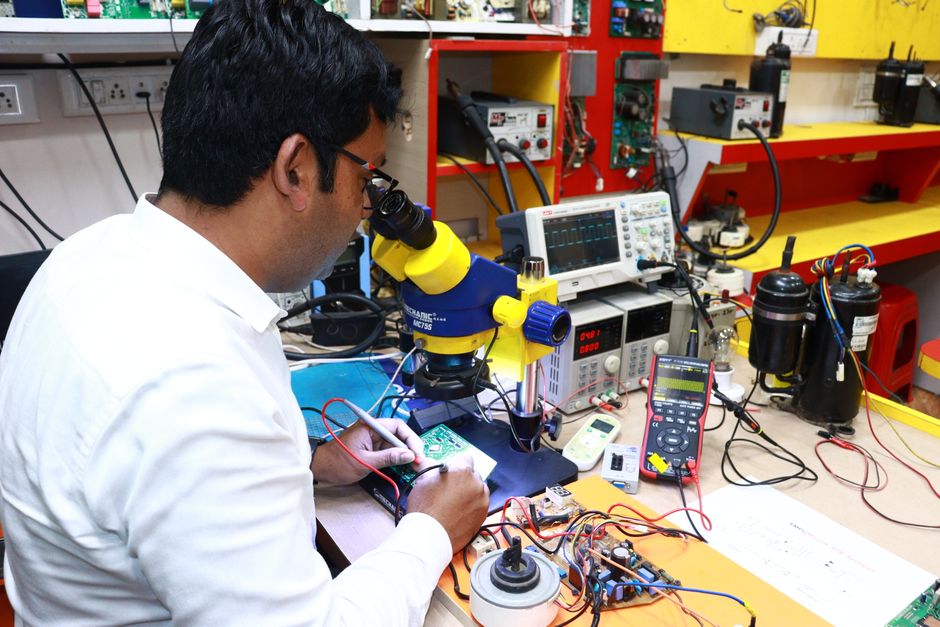
What Do Electronic Engineering Courses Cover?
Electronic engineering courses combine maths, physics, circuits, programming, labs, and specialist options that vary by university.
What Is the Electrical Engineering Degree Online Cost?
Online electrical engineering degree cost depends on credits, tuition, fees, materials, residency, transfer credits, and aid.
How Do You Choose an Electrical Engineering Bachelors Degree Online?
Compare accreditation, labs, transfer credits, total cost, and course schedules before choosing an online electrical engineering bachelor's degree.
How Do I Start Learning Electrical Engineering?
Refresh core math, learn circuit laws, then pair each concept with a safe experiment and a focused project.